Why Do Trash Can Pedals Fail? – 7 Critical Quality Checkpoints For Buyers
Why Do Trash Can Pedals Fail? 7 Critical Quality Checkpoints For Buyers
Most trash can pedal failures are caused by the interaction of moving components rather than a single defective part. Buyers should evaluate pedal structure, linkage alignment, hinge stability, spring performance, lid weight, assembly consistency, and durability testing before placing an order.
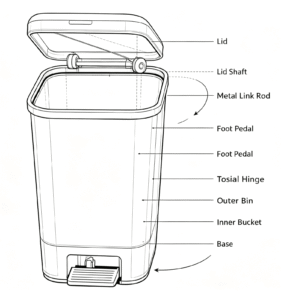
A trash can may look identical on the outside, yet perform very differently after months of daily use.Full pedal bin mechanical exploded diagram
For importers, private label brand owners, retail buyers, procurement managers and hospitality purchasers, pedal durability is one of the most common quality concerns. It directly impacts end-user experience, product return rates and long-term brand reputation.
Rather than simply asking if a pedal is sturdy enough, experienced procurement teams analyze the full pedal mechanism design, assembly standards and factory quality inspection procedures before mass production.
1. Why Is the Pedal the Most Failure-Prone Component?
Core Conclusion: The pedal mechanism is the only part of a trash can that experiences repeated mechanical movement, making it naturally more susceptible to wear than static components.
Explanation
Unlike the stationary stainless steel bin body, the pedal system transfers physical force through multiple connected parts every time the lid opens. Every opening cycle coordinates the pedal, linkage, hinge, return spring and lid together. Minor misalignment or weak performance in any single part will gradually damage overall operation over thousands of uses.
Buyer Practical Advice
When auditing a supplier, assess the entire pedal system as a complete unit, instead of checking individual components separately.
Engineering Note
A pedal mechanism is a dynamic assembly. Long service life relies on coordinated synergy of all moving parts, not just the thickness or hardness of one single piece.
2. What Components Make Up a Complete Pedal Mechanism?
Core Conclusion: A pedal mechanism consists of several interconnected components, each contributing to smooth operation and long-term durability.
Full Standard Component List
Foot pedal
Lever arm
Connecting rod linkage
Hinge assembly
Return spring
Lid linkage bracket
Mounting brackets
Fixed fasteners
Explanation
Structural designs vary slightly between manufacturers, but all these parts work as one integrated mechanical system. If any component loosens, shifts out of alignment or suffers excessive wear, users will notice uneven lid lifting, delayed soft close, heavy foot pressure or abnormal clicking noise.
Buyer Practical Advice
Request suppliers to fully explain their pedal assembly structure, do not rely only on finished product photos to judge quality.
Engineering Note
Mechanical stability depends more on precise component alignment than the total quantity of parts used.
3. Five Key Factors That Lead To Pedal Failure
Factor 1: Pedal Lever Geometry
Core Conclusion: The geometry of the pedal lever influences how efficiently force is transferred from the foot pedal to the lid.
Well-balanced lever geometry reduces foot pressure required to lift the lid and keeps movement consistent long-term. Poor structural angles create uneven stress on linkage and increase wear speed.
Test sample pedals repeatedly, compare foot pressure and pedal travel range across different supplier samples, do not judge quality only by outer appearance.
Optimized force transmission comes from balanced geometric design, not thicker metal materials alone.
Factor 2: Linkage Alignment
Core Conclusion: Smooth pedal operation depends on accurate alignment between connected moving parts.
Misaligned linkage creates extra friction during operation, accelerates component wear and causes unstable lid movement. Alignment accuracy directly reflects the factory’s standardized assembly workflow.
Operate the pedal dozens of times during sample check, observe if lid movement stays smooth, steady and free of jitter or friction noise.
Stable mass assembly standards deliver better long-term performance than high-quality single loose parts.
Factor 3: Hinge Stability
Core Conclusion: A stable hinge helps the lid open and close consistently. Even a well-designed pedal mechanism can feel unreliable if the hinge lacks stability.
All pedal force transfers to the hinge during every use. Loose clearance, poor fixing or offset positioning will make lids wobble, close unevenly or shift position after repeated daily use, especially in high-traffic hotel, office and public commercial scenarios.
Take below steps: 1. Open and close the lid continuously multiple times 2. Check if the lid stays centered without wobbling 3. Confirm both sides of the lid seal evenly when closed 4. Listen for abnormal friction or clicking sounds
If performance changes after short testing, ask the supplier how they control hinge consistency during mass production. Qualified hinges guide the lid along a fixed repeatable path; consistent positioning matters more than raw material thickness.
Factor 4: Return Spring Performance
Core Conclusion: The return spring influences how naturally the pedal returns after each operation, but it is only one element of the overall mechanism.
Weak springs leave pedals stuck halfway down; overly stiff springs force users to apply extra foot pressure. Ideal performance relies on balanced matching between spring tension, lever geometry, linkage stroke and lid weight.
Press the pedal with normal foot strength, observe three indicators: smooth pedal rebound, no stuck mid-position, uniform lid closing every time.
Increasing spring tension does not improve durability; excessive spring force adds extra stress to all other moving parts.
Factor 5: Assembly Consistency
Core Conclusion: Even well-designed components cannot perform consistently without controlled assembly.
Two bins made from identical raw parts can deliver totally different operation experience if assembly tolerance varies. Component positioning, fastener torque, linkage adjustment and final inspection all determine long-term stability. For bulk buyers, repeatable assembly standards are more critical than individual part specifications.
Request multiple samples from the same production batch and compare pedal feel one by one. Uniform operation across units proves stable factory production control.
Stable quality comes from repeatable standardized processes, not occasional perfect single samples.
4. Does Durability Testing Matter For Pedal Mechanisms?
Core Conclusion: Durability testing helps buyers understand whether a pedal mechanism can maintain consistent performance during repeated use. Factories adopt different cycle testing standards, but the core goal is to verify stable operation after thousands of opening & closing cycles. Testing only creates value when it follows fixed written procedures and acts as a formal QC link before shipment.
Instead of simply asking “Do you test pedals?” submit three targeted questions: * What is your full pedal durability testing procedure? * How do you evaluate mechanical performance after cycle testing? * What corrective actions apply if samples fail internal durability standards?
Detailed technical replies prove complete factory quality control systems. Testing verifies production stability; it cannot fix fundamental flaws in product design or assembly standards.
Download our supporting working file: Pedal Mechanism Inspection Checklist PDF for on-site sample audit ✓ Is the pedal movement smooth from beginning to end without jitter? ✓ Does the lid remain centered and aligned during repeated operation? ✓ Does the pedal rebound naturally after releasing foot pressure? ✓ No abnormal friction, clicking or squeaking noise during use? ✓ The lid closes flat and evenly every single cycle? ✓ Multiple batch samples deliver identical pedal operation experience? ✓ Supplier can clearly explain full pedal mechanical design logic? ✓ Factory provides documented inspection and durability testing standards?
6. Common Procurement Mistakes When Evaluating Pedal Bins
1:Most buyers focus visual details such as stainless steel surface finish, color coating or outer packaging during sample review. However, most post-sales complaints originate from hidden moving pedal components instead of static bin bodies.
2. A pedal mechanism that maintains stable performance in sample testing will greatly reduce customer complaints and product returns after mass shipment.
Expert Industry Insight
A widespread misunderstanding: thicker, heavier metal parts equal better pedal durability. In reality, long-term service life depends on balanced mechanical design, precise assembly tolerance and full-process quality control. A well-matched integrated mechanism outperforms a product relying only on single thick heavy components.
Final Buyer Decision Logic
If pedal smoothness and durability are core requirements for your target market, fully audit the mechanism design, assembly workflow and factory QC system, rather than judging products only by exterior appearance. Targeted technical questions before placing OEM orders reduce quality risks and support long-term stable end-user satisfaction.
7. Frequently Asked Questions (FAQ Schema Block)
Q1. Why do trash can pedals fail more often than other components?
Because the pedal mechanism contains multiple moving parts that operate every time the lid is opened. Long-term performance depends on the interaction between the pedal, linkage, hinge, spring, and assembly quality rather than a single component.
Q2. Does a heavier pedal mechanism always mean better quality?
Not necessarily. A heavier mechanism does not automatically provide better durability. Balanced mechanical design, consistent assembly, and reliable quality control are generally more important than weight alone.
Q3. What should buyers inspect when evaluating a pedal trash can sample?
Buyers should observe pedal movement, lid alignment, return action, operating consistency, abnormal noise, and overall mechanical stability. Comparing multiple samples can provide a better understanding of manufacturing consistency.
Q4. How can buyers evaluate a supplier's pedal mechanism capability?
Instead of focusing only on appearance, buyers should ask how the mechanism is designed, assembled, inspected, and tested during production. Clear technical explanations usually indicate stronger engineering support.
Q5. Is durability testing important for pedal mechanisms?
Yes. Durability testing helps verify whether the mechanism continues to operate consistently after repeated use. Buyers should understand the supplier’s testing process rather than only requesting a test report.
Q6. What industries require higher pedal durability?
Hotels, offices, healthcare facilities, schools, and public buildings generally require products that can withstand frequent daily operation over long service periods.
Q7. Can a well-designed pedal mechanism reduce after-sales issues?
A well-designed and consistently assembled pedal mechanism can improve user experience and reduce quality complaints related to operation, lid alignment, and opening performance.
Q8. What is the most important factor when choosing a pedal trash can manufacturer?
Engineering capability, manufacturing consistency, quality control, and communication are often more important than product appearance or price alone.
A stainless steel trash can is more than its polished exterior. Surface treatment, custom packaging and private label branding boost market competitiveness, yet end-user satisfaction largely relies on invisible internal mechanical components. The pedal mechanism is the most critical among these hidden parts. For global procurement buyers, learning to assess pedal design, assembly standards and factory inspection rules before mass production effectively cuts quality risks and optimizes purchasing decisions. Selecting a supplier is never just purchasing finished goods — it is partnering with a manufacturer that can deliver consistent stable quality long-term.

One Response